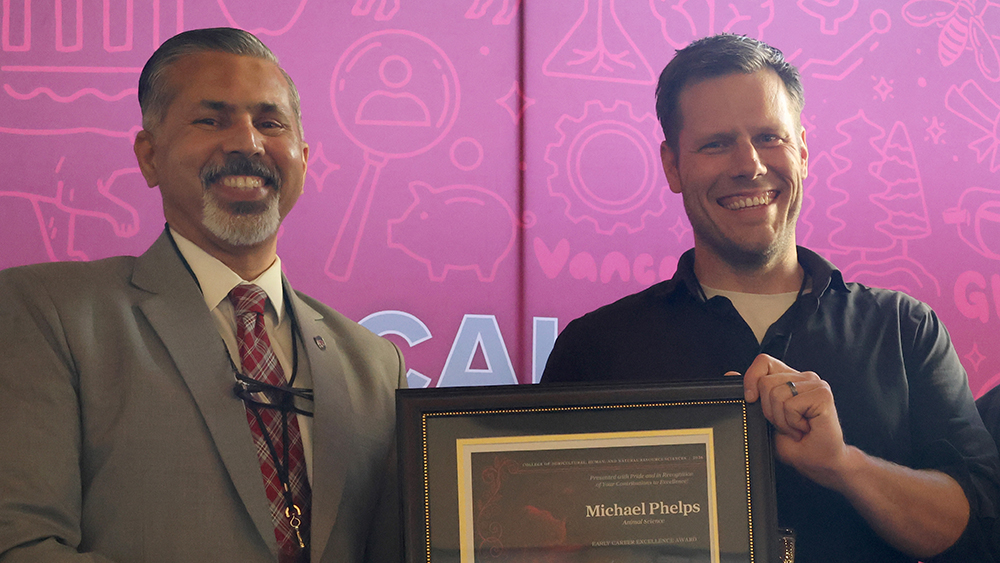
On April 30, 2026, Dr. Michael Phelps was awarded the CAHNRS Early Career Excellence Award, recognizing his extraordinary impact on research, teaching, and innovation in aquaculture and fish physiology at Washington State University (WSU). This honor reflects Dr. Phelps’ exceptional early-career accomplishments, his resilience in the face of significant challenges, and his pivotal role in positioning WSU as a national and global leader in aquaculture science.
Dr. Phelps joined WSU in July 2019 as an Assistant Professor in the Department of Animal Sciences and as the department’s first faculty member with expertise in fish physiology. Upon arrival, he was provided outdated and rudimentary aquaculture facilities. Undeterred, Dr. Phelps invested more than $350,000 of his own resources to modernize fish-rearing infrastructure, transforming the facility into a highly functional and competitive research environment and dramatically increasing its research capacity.
He has since built one of the few laboratories in the world capable of reliably gene-editing salmonids, a scientific challenge due to genome duplication and variable ploidy (diploid, triploid, and tetraploid) in trout and salmon. Dr. Phelps’ program has generated more than 70 targeted gene-edited trout lines, the most of any program globally. These gene-edited lines—now reaching maturity—offer unparalleled research opportunities and represent a substantial source of future intellectual property for CAHNRS and WSU. His work positions WSU at the forefront of a rapidly evolving global movement toward gene-edited aquaculture species that enhance food security and environmental resilience.
Dr. Phelps’ research focuses on advancing aquaculture genetics and physiology to address environmental stressors such as rising water temperatures. His laboratory is also developing AI-based fish screening and phenotypic assessment tools to accelerate gene-editing outcomes and improve selective breeding efficiency. Despite early setbacks—including COVID-19–related supply disruptions and the loss of experimental fish during the 2021 Palouse heat wave—Dr. Phelps successfully established foundational research models, attracted graduate students, and built sustained campus-wide momentum for fish physiology and aquaculture.
Since joining WSU, Dr. Phelps has secured $9.19 million in external research funding, with an additional $42 million currently pending. He played a critical role in securing $49.5 million in federal aquaculture appropriations and was a key contributor to a recently awarded $50 million federal grant establishing an Aquaculture Center of Excellence at WSU’s Pullman and Puyallup campuses. These efforts are widely regarded as transformative, substantially elevating WSU’s national and international profile in aquaculture research and training. His industry engagement has also generated nearly $200,000 in gift support, along with significant in-kind contributions such as regular provision of salmonid eggs for gene-editing research.
An outstanding educator, Dr. Phelps is currently the only faculty member on campus offering fish physiology coursework. His courses receive exceptional student evaluations and have experienced continuous enrollment growth, now serving as writing-in-the-major requirements and departmental capstone courses. He founded the WSU Aquaculture Club, provides instructional support across undergraduate and graduate curricula, and has mentored nearly 40 undergraduate researchers. His graduate students have gone on to highly successful careers without exception.
Known for his engaging communication style, collegiality, and upbeat disposition, Dr. Phelps is a sought-after speaker for conferences, industry events, recruitment activities, and prospective student engagements. Personally driven by a lifelong passion for science, Dr. Michael Phelps embodies excellence in research, teaching, and service—qualities that make him a highly deserving recipient of the 2026 CAHNRS Early Career Excellence Award.