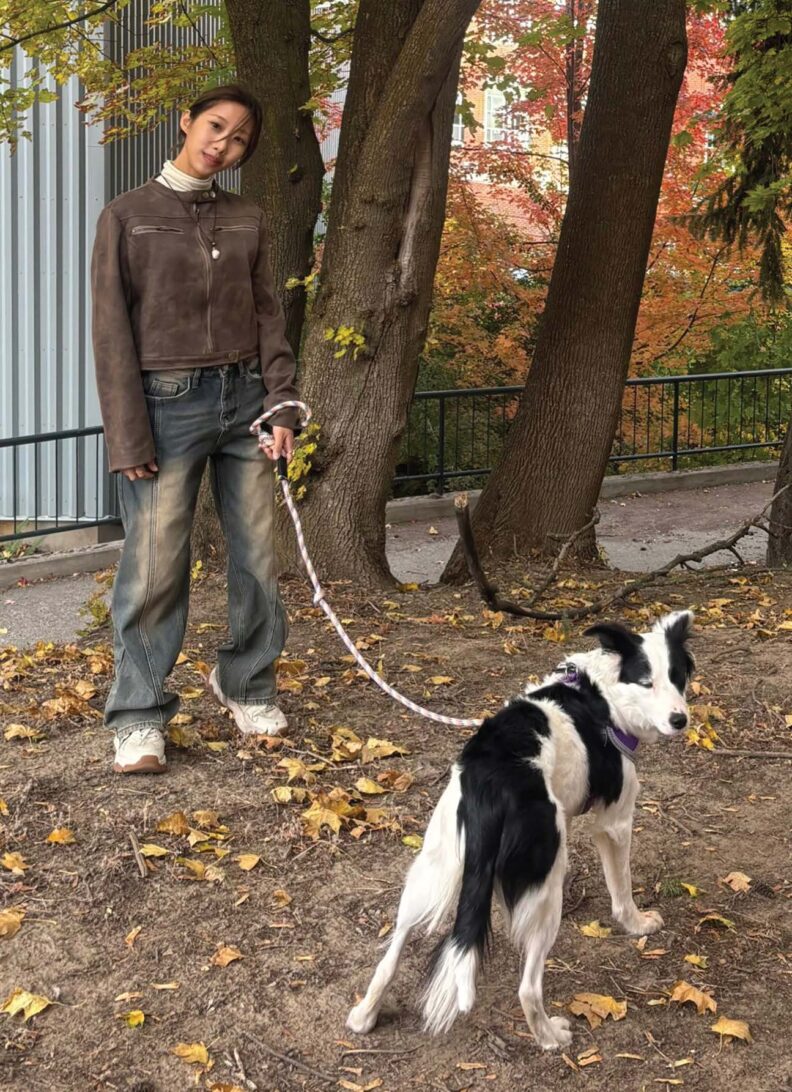
Jennifer Kim’s path to animal sciences at WSU has been shaped by diverse cultures, an eagerness to explore biology, and a drive to improve animal health. Although born in South Korea, Kim grew up mostly in Canada until a family emergency brought her back to Korea. As she grew older, her affection for animals turned into a commitment to help those without homes. She volunteered at shelters and rescue groups, caring for abandoned and neglected pets. These experiences showed her how kindness and service can impact animals’ lives, igniting her passion for veterinary medicine.
Kim took a brief two-year break to study film making before returning to her passion for veterinary medicine. She applied to U.S. programs that met vet school requirements and, in 2023, accepted an offer from WSU to begin studying animal sciences. As she advanced in her coursework, Kim’s interest in animal sciences—especially nutrition—grew. Her instructor, Dr. Nancy Irlbeck, made key concepts clear and engaging by using practical examples, turning early morning lectures into enjoyable learning experiences.
“I used to dread 9 a.m. classes, but Dr. Irlbeck’s class was different,” Kim said. “I looked forward to her stories.”
Kim’s journey took a significant turn when she discovered a summer program in traditional Chinese veterinary medicine (TCVM) at Nanjing Agricultural University. Her prior exposure to traditional Chinese medicine while living in Korea, combined with her passion for integrative medicine, inspired her to apply. With strong support from Dr. Zhihua Jiang’s letter of recommendation, Kim earned a full scholarship to attend the 2025 summer program.
During the two-and-a-half-week program, Kim studied the principles of TCVM, a system used in China for thousands of years to treat animals. TCVM practitioners believe that diseases arise when the body is out of balance, and they diagnose health issues by identifying patterns of disharmony. Treatments aim to restore balance through acupuncture, herbal medicine, food therapy, and Tui-na massage, focusing on acupoints and meridians to enhance energy flow (https://chiu.edu/about/what-is-tcvm).
Kim appreciated engaging with veterinary students from Europe and other regions throughout the program. Together, they studied canine acupoints and explored how acupuncture could benefit horses and various farm animals.
“We could only observe acupuncture practices used to treat dogs,” Kim explained. “But we got to try it on ourselves and each other.”
The TCVM program strengthened Kim’s interest in integrative medicine and renewed her belief that traditional and Western approaches can complement each other, especially in chronic care, prevention, and nutrition. This pivotal experience reinforced her motivation and clarified her vision for her future career.
Today, Kim feels deeply appreciative of the Department of Animal Sciences, where she found both supportive faculty and a wide range of opportunities. She broadened her learning outside of regular coursework by delving into research areas like reproduction, nutrition, and genetics, which helped her clarify her interests. Kim reflected, “Animal science goes beyond loving animals—it’s about understanding the science behind them.”
Motivated by curiosity, empathy, and faith, Kim views animal sciences and veterinary medicine as disciplines that blend scientific exploration, keen observation, and compassionate care. Despite cultural adjustments, academic doubts, and personal obstacles, Kim now feels confident that she belongs in this field and eagerly anticipates supporting both animals and their owners in the future.