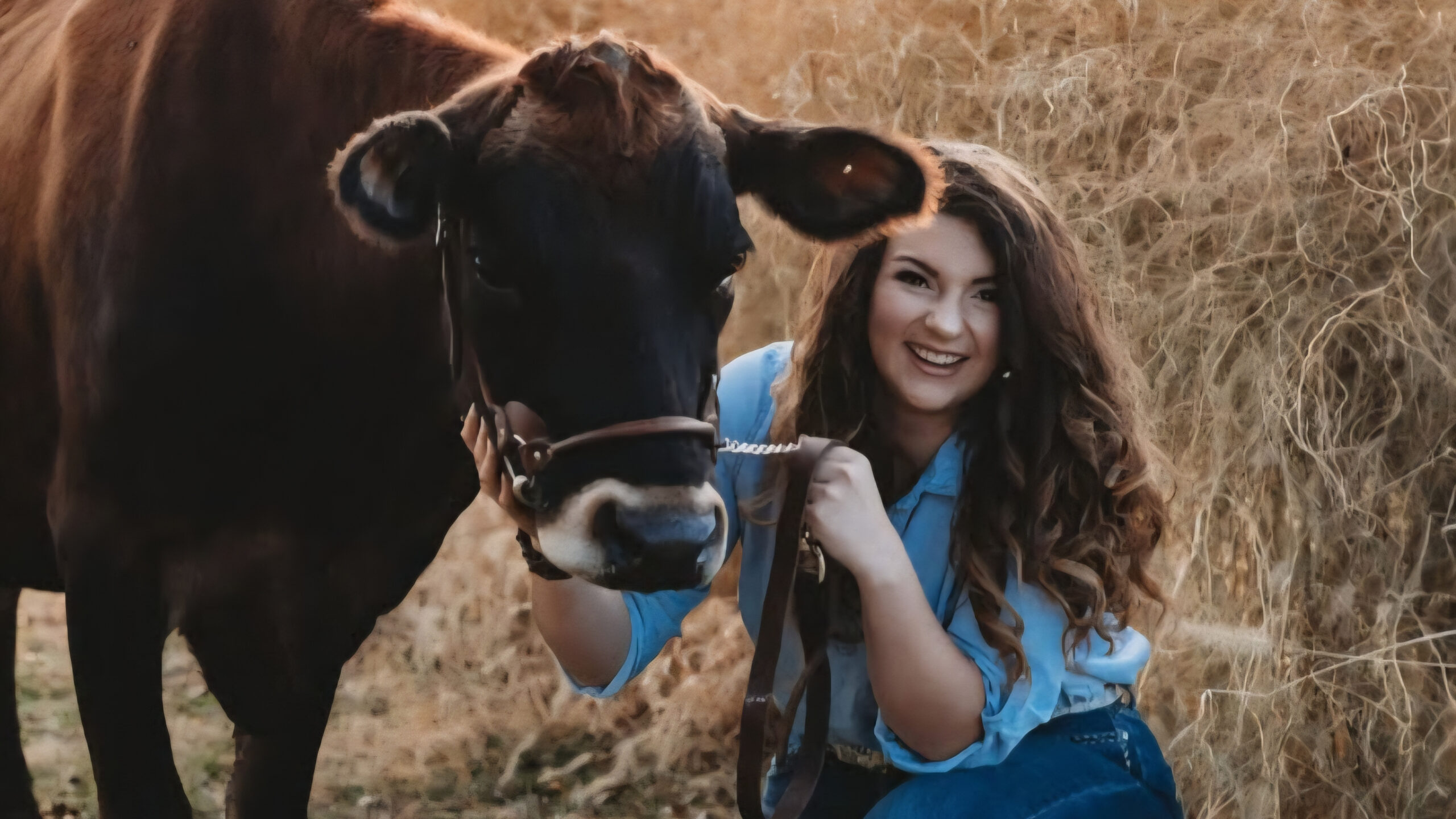
We are excited to introduce Dr. Addison Carroll, a new assistant professor and dairy cattle specialist, who joined us in August 2025. She brings a producer-first mindset to her research and outreach programs.
Background and early interests
Carroll was raised on a cow-calf operation in Missouri and developed an interest in dairy cattle as a teenager raising Holstein steers. As an undergraduate at Northwest Missouri State University, she became interested in nutrition after learning how ruminal microbes convert fiber and carbohydrates into volatile fatty acids, a key energy source for the animal. She later milked for three years on a family-owned Jersey dairy farm, further developing her practical skillset while enhancing her passion for nutrition and dairy production. These early experiences gave her a basic understanding of the links between biological mechanisms and animal performance, subsequently leading her to focus her education on ruminant nutrition.
Carroll earned a BS in animal science with a Spanish minor from Northwest Missouri State University in 2019. She completed her MS in 2021 and PhD in 2024 in ruminant nutrition at the University of Nebraska-Lincoln under Dr. Paul Kononoff. Her graduate work focused on feed pelleting strategies to enhance palatability, energy metabolism, nitrogen utilization, and methane mitigation in dairy cattle.
Research focus and academic roles
Carroll’s role at WSU blends research (65%), Extension (30%), and service (5%). Her primary goal is to help dairy producers maximize nutrient value by improving utilization and reducing nutrient excretion, especially carbon and nitrogen. She emphasized, “I want to ensure more carbon and nitrogen are available for productive purposes, instead of being lost through manure or greenhouse gas emissions.” This ultimately leads her program to evaluate how nutritional and manure management strategies influence the total GHG and nutrient excretion of dairy cattle from head to tail.
Student engagement and mentorship
Students play a key role in her program. Her team consists of six undergraduate students who are gaining important practical experience with dairy cows, data collection, and daily research problem-solving. Carroll notes that, “Watching students’ confidence grow from working with cattle is a key source of joy. No two days are the same when working with animals. Honestly, their teamwork is outstanding and it is my hope they take lessons learned into the future career endeavors.”
She is also actively seeking graduate students to advance her program.
Supporting producers and extension initiatives
In her Extension role, Carroll’s primary objective is to build trust and strong relationships with producers. She aims to provide practical, research-based guidance on nutrient management and sustainability to help producers address regulatory requirements and improve profitability. She also plans to assess and communicate how environmental metrics apply to local dairies, serving as a resource and advocate when models or assumptions do not reflect on-farm realities.
“It is essential that we focus on economic sustainability first, and evaluate how new technologies support both economic and environmental sustainability,” Carroll stated, noting the distinct challenges faced by Washington dairy producers.
Personal interests
To unwind, Carroll enjoys gardening, especially tending her cut-flower garden. She is also looking forward to harvesting apples from her front yard this fall.
Carroll looks forward to meeting and talking directly with producers and students, whether that is talking through on-farm challenges, identifying research questions that matter, or helping students explore careers in dairy science. She also shared that new regional Extension educational programs are in development, with workshops tentatively planned for the fall.
Looking ahead
As she settles into her role at WSU, Carroll aims to create a program that delivers practical, science-based solutions for Washington dairies. She is dedicated to interacting directly with producers and educating students, thereby positioning the Department of Animal Sciences as a trusted partner in addressing the state’s most pressing dairy challenges.