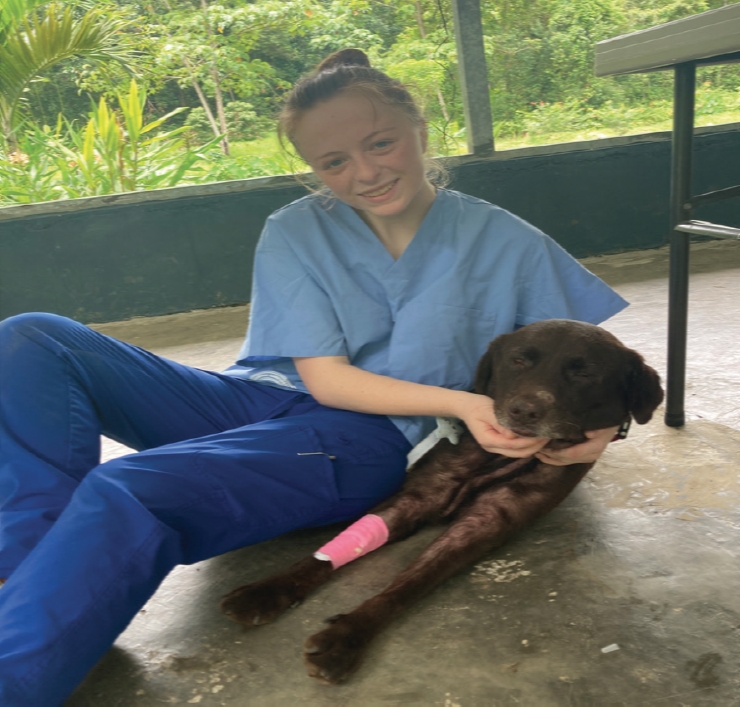
Studying abroad had never been on Keliann Stephens’s radar until she heard about a veterinary field training mission in Costa Rica operated by the Maderas Rainforest Conservancy (maderasrfc.org). This program was designed to expose pre-veterinary students to the challenges of veterinary medicine in a developing country.
“I’ve never been abroad and haven’t even traveled far from home,” she said. “But I decided the experience would be great for me and would be a real test to see if this is what I want to do.”
So, the animal sciences junior from Moses Lake applied and was accepted for a session in July 2024. She flew to San Jose, Costa Rica, and met up with 18 other undergraduate students from around the U.S. The group traveled to the La Suerte Biological Field station in northeastern Costa Rica, located in one of the most biologically diverse regions in the world, home to thousands of plant and insect species along with hundreds of species of amphibians, reptiles, birds, and mammals. They shared rooms in housing at the field station and quickly learned how to amuse themselves without any cell phone service.
“Some people went through phone withdrawals because there was no cell service where we were,” Stephens said. “I thought that was great. We did what most people did before technology and played board and card games all night.”
For nine days, Stephens collaborated with local veterinarians and other volunteers in the Costa Rican rainforest, providing medical care to large and small animals in need. Initially, she attended classroom sessions where she acquired fundamental clinical knowledge, including diagnostics and treatment methodologies. Subsequently, she participated in hands-on clinical work, filling out paperwork and performing supervised physical examinations on dogs and cats. This included weighing animals, estimating body condition scores, measuring body temperatures, collecting heart and respiratory rates, and assessing lymph node sizes. She conducted fecal flotation tests to diagnose internal parasitic infections and dispensed medications to pet owners. Additionally, she gained experience in preparing small animals for surgery, observed veterinarians as they spayed and neutered dogs and cats, and assisted in the surgical recovery station. During the large animal day, the volunteers accompanied the veterinarians into the field, learning how to palpate cows for pregnancy diagnosis and assisting with dehorning and deworming procedures.
The program also included a field day, allowing Stephens and the other volunteers to see more of the rainforest and other local surroundings. They were able to observe sloths in their natural environment and witness the release of a turtle back into the ocean.
“This was the most incredible experience ever,” Stephens said. Despite not receiving any college credit for the mission, she emphasized, “It was a cool learning experience, and I highly recommend it to everyone!”
Stephens is finishing her junior year and is busy with the Student Swine Cooperative, starting her vet school application for fall 2026, and considering another veterinary mission trip this summer in Ecuador. Her experiences in the South American rainforest will aid her in writing a compelling vet school application essay.